
Australia is home to some of the most unusual animals on Earth. Because the continent was separated from other landmasses for millions of years, many species evolved in ways not seen anywhere else. When students learn about the Animals of Australia, they discover mammals that lay eggs, birds that cannot fly well, reptiles adapted to dry deserts, and sea creatures living around the Great Barrier Reef. These animals are not only interesting; they also help us understand habitats, adaptation, food chains, and conservation.
Why are Australian animals so unique?
Australia’s wildlife is special because of isolation. Long ago, Australia became separated from other continents. Over time, its animals developed their own features to survive in forests, deserts, grasslands, wetlands, and coastal waters. This is why many Australian animals are endemic, meaning they are found naturally in Australia and nowhere else in the wild.
Another reason Australian animals are unique is the country’s wide range of environments. The hot, dry Outback is very different from tropical rainforests in Queensland or cold mountain regions in Tasmania. Each habitat supports animals with different body shapes, diets, and behaviors.
- Marsupials are common in Australia; their babies continue growing in a pouch after birth.
- Monotremes, such as the platypus and echidna, are mammals that lay eggs.
- Many species have adaptations for heat, drought, and long distances.
- Australia has important marine habitats, including coral reefs, seagrass beds, and rocky coastlines.
Famous mammals of Australia
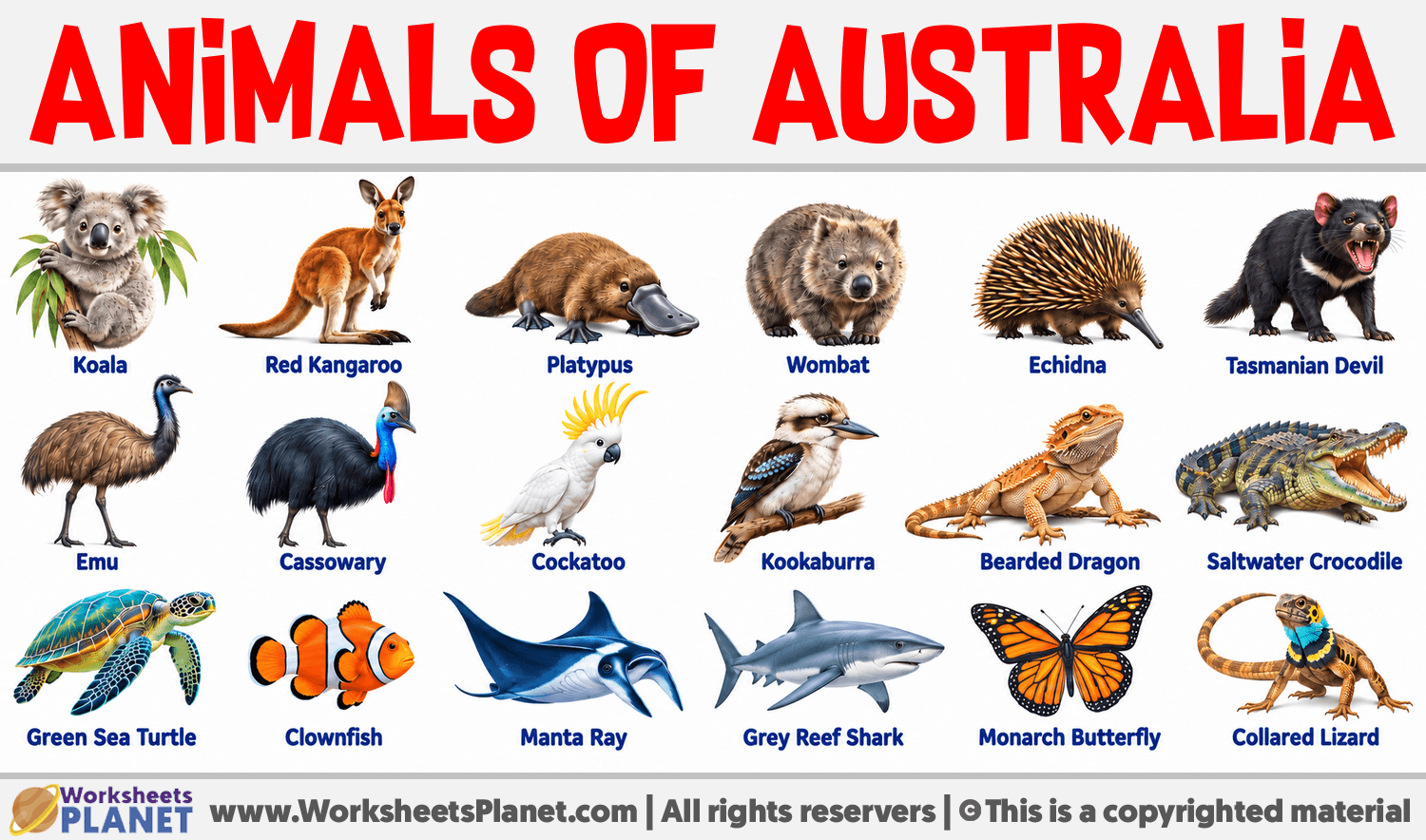
Some of the best-known Australian animals are mammals, especially marsupials. Kangaroos are powerful jumpers with strong hind legs and long tails for balance. They live in groups called mobs and eat grasses and plants. A red kangaroo can travel quickly across open land, which helps it find food and water in dry areas.
Koalas are another famous Australian mammal, but they are not bears. They are marsupials that spend much of their lives in eucalyptus trees. Koalas mostly eat eucalyptus leaves, which are tough and low in energy, so they sleep for many hours each day. Their sharp claws help them climb, and their strong sense of smell helps them choose suitable leaves.
Wombats, wallabies, possums, and Tasmanian devils are also important examples. Wombats dig burrows and have strong bodies for moving soil. Tasmanian devils are meat-eating marsupials found in the wild only in Tasmania. They help the ecosystem by eating carrion, which means dead animals.
- Kangaroo: a grazing marsupial known for jumping and carrying young in a pouch.
- Koala: a tree-dwelling marsupial that feeds mainly on eucalyptus leaves.
- Wombat: a burrowing plant-eater with powerful claws.
- Tasmanian devil: a carnivorous marsupial with a loud call and strong jaws.
- Platypus: an egg-laying mammal with a duck-like bill and webbed feet.
Birds, reptiles, and insects in Australian habitats
Australia has many remarkable birds. The emu is a large flightless bird that can run fast across open country. Kookaburras are known for their laughing call, while cockatoos and lorikeets are colorful parrots often seen in trees and gardens. Many Australian birds spread seeds or help control insect populations, making them important for healthy ecosystems.
Reptiles are also common, especially in warm and dry places. Australia has many lizards, snakes, turtles, and crocodiles. The saltwater crocodile, found in northern Australia, is the largest living reptile. Some snakes are venomous, but they usually avoid people if left alone. Learning about reptiles helps students understand cold-blooded animals, which rely on the environment to regulate body temperature.
Insects and spiders are smaller but just as important. Bees, butterflies, ants, beetles, and termites all play roles in pollination, soil health, and food chains. Termites, for example, help break down plant material and create large mounds in some parts of Australia.
- Emus cannot fly well, but they run quickly and travel long distances.
- Kookaburras belong to the kingfisher family and are famous for their call.
- Frilled-neck lizards use a large neck frill to appear bigger when threatened.
- Saltwater crocodiles live near rivers, wetlands, and coastal areas in northern Australia.
Marine animals around Australia
Australia is surrounded by oceans, so its marine animals are an important part of its wildlife. The Great Barrier Reef is one of the world’s largest coral reef systems and provides shelter for thousands of species. Fish, sea turtles, reef sharks, rays, clams, and corals all live together in this underwater habitat.
Sea turtles nest on Australian beaches and travel long distances through the ocean. Dugongs, sometimes called sea cows, feed on seagrass in shallow coastal waters. Dolphins and whales can also be seen around Australia’s coast. Humpback whales migrate each year between cold feeding waters and warmer breeding areas.
Coral reefs are delicate ecosystems. Corals may look like plants or rocks, but they are actually tiny animals living in colonies. They need clean, warm, sunlit water to survive. When ocean temperatures rise too much, corals can lose the algae that give them food and color, a process called coral bleaching.
- Clownfish, parrotfish, and angelfish are examples of reef fish.
- Green sea turtles feed on seagrass and algae.
- Dugongs depend on healthy seagrass beds.
- Humpback whales migrate along the Australian coast.
Threats to Australian animals and how people can help
Many animals of Australia face threats from habitat loss, climate change, pollution, bushfires, and introduced species. Introduced species are animals or plants brought by humans to places where they did not originally live. Foxes, cats, rabbits, and cane toads have caused serious problems for some native animals by hunting them, competing for food, or changing habitats.
Bushfires are a natural part of some Australian environments, but very intense fires can destroy homes, forests, and food sources for wildlife. Droughts and rising temperatures can also make survival harder, especially for animals that depend on specific plants, wetlands, or cool habitats.
People can help by protecting habitats, supporting wildlife rescue groups, reducing plastic waste, keeping pets under control, and learning about native species. In schools, studying Australian animals can build curiosity and respect for nature. Students can compare adaptations, create habitat diagrams, or research one endangered species and explain why it needs protection.
- Protect native habitats such as forests, wetlands, grasslands, and reefs.
- Keep cats indoors or supervised to reduce hunting of native wildlife.
- Avoid litter, especially plastic that can harm birds and marine animals.
- Learn the difference between native species and introduced species.
- Support conservation projects that monitor and restore animal populations.

Leave A Comment