
Matter is everything that has mass and takes up space. The air we breathe, the water we drink, the chair we sit on, and even our own bodies are made of matter. In elementary and middle school science, students usually begin by learning about The 3 states of Matter: solids, liquids, and gases. These states help us describe how materials look, feel, move, and change when they are heated or cooled. Understanding them is important because they appear in everyday life, from melting ice cream to steam rising from a hot drink.
What are the 3 states of matter?
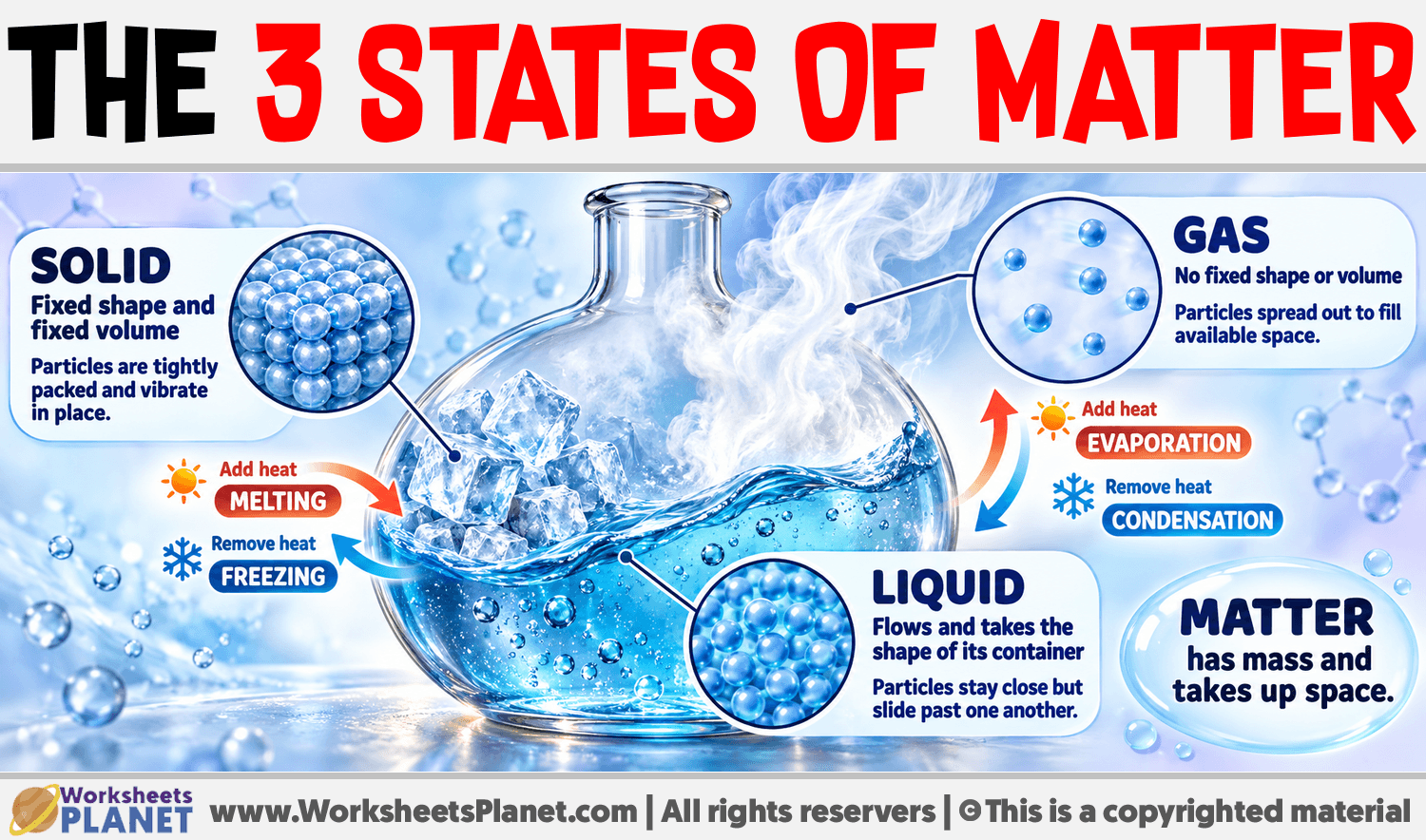
The three common states of matter are solid, liquid, and gas. Each state depends on how the tiny particles that make up matter are arranged and how they move. These particles are too small to see with our eyes, but they explain why a rock keeps its shape, why juice pours into a glass, and why air spreads around a room.
A useful way to think about the states of matter is to compare their shape and volume. Shape means the form something has. Volume means the amount of space it takes up. Solids, liquids, and gases behave differently because their particles have different amounts of energy.
- Solids have a fixed shape and a fixed volume.
- Liquids have a fixed volume but take the shape of their container.
- Gases do not have a fixed shape or fixed volume; they spread out to fill the space available.
Solids: matter with a fixed shape
A solid is a state of matter that usually keeps its own shape. The particles in a solid are packed closely together and can only vibrate in place. Because the particles cannot move freely past one another, solids feel firm and are often hard to squeeze or pour.
Examples of solids include a pencil, a book, a coin, a table, a brick, and an ice cube. Some solids are hard, like metal or stone. Others are soft, like clay, rubber, or a sponge. Even though soft solids can bend or change shape when force is applied, they are still solids because they do not flow like liquids.
- A solid has a definite shape.
- A solid has a definite volume.
- Its particles are closely packed.
- It may be hard, soft, smooth, rough, heavy, or light.
Liquids: matter that flows
A liquid is matter that flows and takes the shape of its container. If you pour water from a bottle into a cup, the water changes shape to fit the cup, but the amount of water stays the same unless some spills or evaporates. This is why liquids have a fixed volume but not a fixed shape.
The particles in a liquid are close together, but they can slide past one another. This movement allows liquids to pour, splash, drip, and form puddles. Common examples include water, milk, oil, juice, and liquid soap. Some liquids flow quickly, like water, while others flow slowly, like honey or syrup. The thickness of a liquid is called viscosity.
- Liquids can be poured from one container to another.
- They have a surface that usually stays level when still.
- They take the shape of the bottom part of their container.
- Some liquids mix together, while others, like oil and water, may separate.
Gases: matter that spreads out
A gas is matter that spreads out in every direction. Unlike solids and liquids, gases do not have a fixed shape or a fixed volume. The particles in a gas are far apart and move quickly. They bump into one another and into the sides of their container, which is why gases can fill a balloon, a tire, or an entire room.
Air is the most familiar example of a gas. We cannot usually see air, but we can feel it when the wind blows or when we wave a hand quickly. Other gases include oxygen, carbon dioxide, helium, and water vapor. A balloon filled with helium rises because helium is lighter than the air around it.
Gases are important for life and weather. Humans and animals need oxygen to breathe. Plants use carbon dioxide to make food during photosynthesis. Water vapor in the air helps form clouds, rain, snow, and other weather conditions.
- Gases spread out to fill all available space.
- They can be compressed, or squeezed, more easily than solids and liquids.
- Many gases are invisible, but they are still matter because they have mass and take up space.
How matter changes from one state to another
Matter can change state when it gains or loses energy, usually in the form of heat. These changes are called changes of state or phase changes. The material itself may still be the same substance, even though it looks different. For example, ice, liquid water, and water vapor are all forms of water.
When ice is heated, its particles gain energy and move more. The solid ice melts into liquid water. If the water is heated more, it can evaporate or boil and become water vapor, a gas. When water vapor cools, it can condense back into liquid water. If liquid water becomes cold enough, it freezes into ice again.
These processes happen all around us. Puddles dry after rain because water evaporates. Drops form on the outside of a cold glass because water vapor in the air condenses. Frost forms when water changes into a solid on very cold surfaces.
- Melting: solid changes to liquid, such as ice turning into water.
- Freezing: liquid changes to solid, such as water turning into ice.
- Evaporation: liquid changes to gas at the surface, such as a puddle drying.
- Condensation: gas changes to liquid, such as water droplets forming on a mirror.
- Boiling: liquid changes rapidly into gas when it reaches its boiling point.
Everyday examples students can observe
Learning about the 3 states of Matter is easier when students connect science ideas to real objects and events. A kitchen, classroom, playground, or bathroom can become a simple science lab with safe observations. Students can compare an ice cube, a cup of water, and the steam from warm water to see how one substance can appear in different states.
Teachers and parents can ask questions that encourage careful thinking: Does it keep its shape? Can it be poured? Does it fill the container? What happens when it is heated or cooled? These questions help students use evidence instead of guessing.
It is also helpful to remind students that not all matter is easy to see. Air is invisible, but it takes up space. A simple proof is blowing up a balloon. The balloon gets bigger because air enters it and fills the space inside.
- A solid: an eraser, apple, spoon, or block.
- A liquid: water, milk, paint, or cooking oil.
- A gas: air in a balloon, steam from hot water, or carbon dioxide bubbles in soda.
- A state change: ice melting, water freezing, or a mirror fogging after a shower.

Leave A Comment