
A tarantula is a large, hairy spider that belongs to a group of spiders called theraphosids. Although tarantulas may look scary at first, their bodies are fascinating examples of how animals are adapted to survive. Learning the parts of a tarantula helps students understand how spiders move, sense the world, catch food, defend themselves, and grow. Like all spiders, a tarantula is an arachnid, not an insect. This means it has eight legs, no antennae, and a body divided into two main sections.
What are the two main body sections of a tarantula?
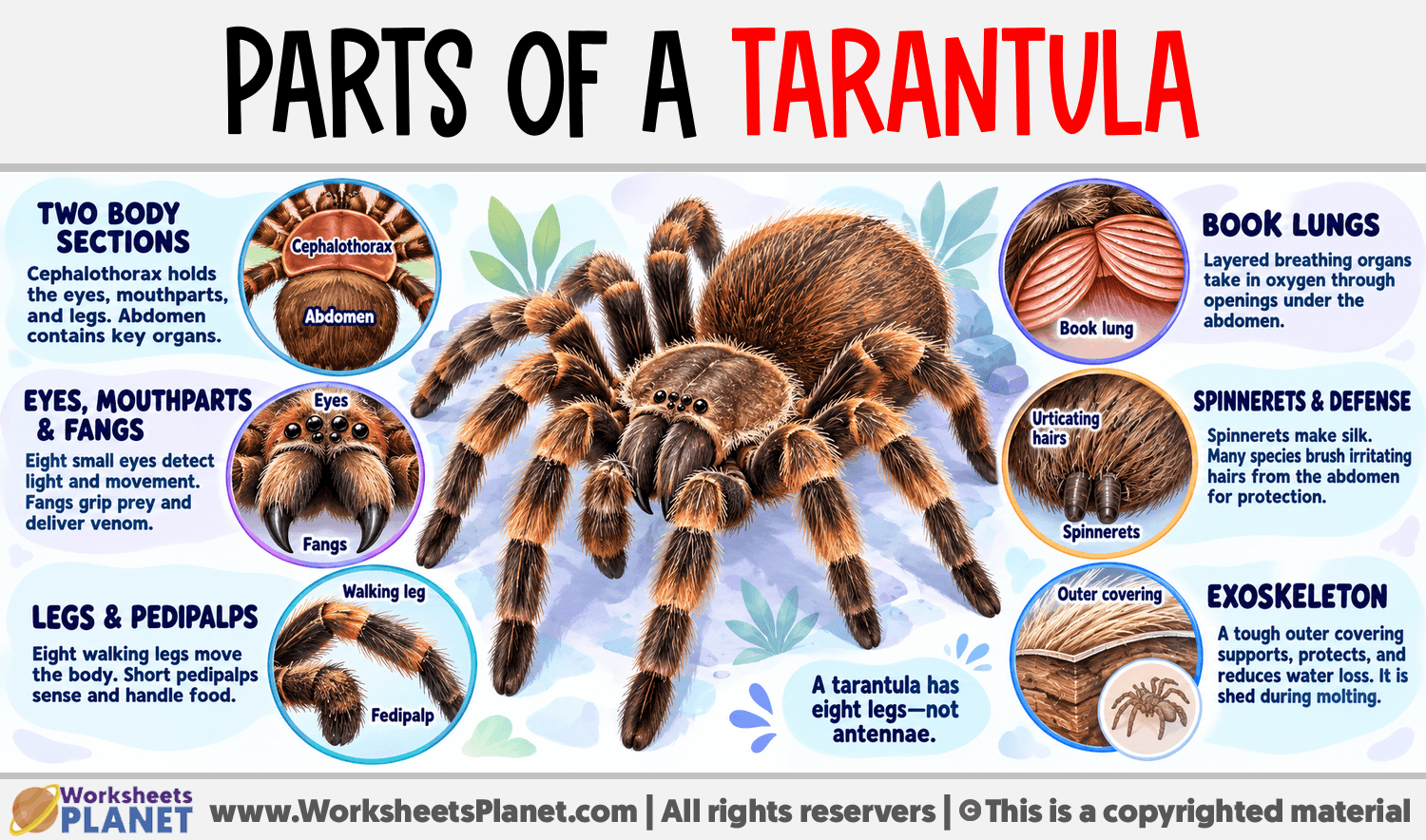
The body of a tarantula is divided into two main parts: the cephalothorax and the abdomen. These sections are joined by a narrow waist-like area called the pedicel. This body plan is different from insects, which have three main body parts: head, thorax, and abdomen.
The cephalothorax is the front section. It is a combined head and chest area, covered by a hard plate called the carapace. This part holds the eyes, mouthparts, fangs, pedipalps, and legs. The cephalothorax is especially important because it controls movement, feeding, and sensing the environment.
The abdomen is the larger, softer back section of the tarantula. It contains important organs, including parts of the digestive, breathing, and reproductive systems. The abdomen also carries the spinnerets, which are used to produce silk. In many New World tarantulas, the abdomen is covered with special defensive hairs called urticating hairs.
- Cephalothorax: front body section that holds the eyes, legs, fangs, and mouthparts.
- Abdomen: back body section that contains organs, silk-producing spinnerets, and often defensive hairs.
- Pedicel: small connection between the cephalothorax and abdomen, allowing flexibility.
How do tarantula legs and pedipalps help them move and sense?
One of the most noticeable parts of a tarantula is its set of eight walking legs. Each leg is made of several jointed segments, which allow the spider to walk, climb, dig, and grip surfaces. Tarantulas do not have bones inside their bodies. Instead, they have an outer skeleton called an exoskeleton, and their leg movement depends partly on muscles and body fluid pressure.
Tarantulas are often slow, careful walkers, but some species can move quickly when startled. Their feet have tiny hairs and claw-like structures that help them grip the ground, bark, leaves, or burrow walls. These sensitive hairs also detect vibrations, which is important because tarantulas do not rely mainly on sharp eyesight.
Near the mouth are two shorter appendages called pedipalps. At first glance, they may look like an extra pair of small legs, but they are not used in exactly the same way. Pedipalps help the tarantula touch and examine objects, hold prey, and guide food toward the mouth. In adult male tarantulas, the pedipalps also play a role in reproduction.
- Legs help with walking, climbing, digging, and balance.
- Sensory hairs on the legs detect touch, air movement, and vibrations.
- Pedipalps help the tarantula feel, hold prey, and handle food.
What are the mouthparts, fangs, and eyes used for?
Tarantulas have mouthparts designed for catching and eating small animals such as insects, crickets, beetles, and sometimes small vertebrates. Their most famous mouthparts are the fangs, which are attached to structures called chelicerae. Unlike many spiders whose fangs move sideways, tarantula fangs move up and down, like a pair of tiny daggers.
The fangs inject venom into prey. This venom helps subdue the animal and begins the process of breaking down tissues. Tarantulas cannot chew food the way humans do. Instead, they use digestive juices to turn the inside of the prey into liquid, which they then suck up.
Tarantulas usually have eight eyes arranged on a small raised area on the cephalothorax. However, their eyesight is generally not very strong. They can sense light, dark, and movement, but they depend much more on vibrations and touch. This is why sudden movement or tapping near a tarantula can startle it.
How do tarantulas breathe, make silk, and protect themselves?
Tarantulas breathe using special organs called book lungs. These are found on the underside of the abdomen. They are called book lungs because their thin layers look a little like the pages of a book. Air enters through small openings, and oxygen passes into the tarantula’s body.
Another important part of the abdomen is the spinnerets. Spinnerets are small finger-like structures at the back of the body that produce silk. Tarantulas do not usually build sticky webs to catch flying insects like some other spiders do. Instead, they use silk for practical tasks. They may line their burrows with silk, create a soft mat before molting, wrap egg sacs, or leave silk trails that help them sense movement nearby.
Some tarantulas, especially those from the Americas, have urticating hairs on their abdomen. When threatened, they can flick these tiny barbed hairs into the air using their back legs. The hairs can irritate the skin, eyes, or nose of a predator. This defense helps the tarantula avoid danger without needing to bite.
- Book lungs allow the tarantula to breathe.
- Spinnerets produce silk for burrows, egg sacs, and safety mats.
- Urticating hairs can irritate predators and help protect the tarantula.
Why is the exoskeleton important to a tarantula’s body?
A tarantula’s body is covered by an exoskeleton, which acts like armor. It protects the soft organs inside and gives the body shape. The exoskeleton also provides places for muscles to attach, making movement possible. However, it cannot grow larger in the same way skin does.
As a tarantula grows, it must shed its old exoskeleton in a process called molting. Before molting, the tarantula may stop eating and become less active. It often lies on its back or side while it carefully pulls itself out of the old outer covering. This can look alarming, but it is a normal and important part of the tarantula’s life cycle.
After molting, the new exoskeleton is soft and delicate. The tarantula needs time to harden before it can safely eat or defend itself. Even the fangs are soft at first and may appear pale or white. For students, molting is a useful example of how animal body parts are connected to growth and survival.
Understanding the parts of a tarantula shows that this animal is not just a “big spider,” but a well-adapted creature with specialized body structures. Its legs sense vibrations, its fangs help it feed, its spinnerets produce silk, and its exoskeleton protects it. Each part has a job, and together they help the tarantula live successfully in its habitat.

Leave A Comment