
A penguin is a flightless bird that is specially adapted for life in the water. Penguins are known for their black-and-white bodies, upright walk, and excellent swimming skills. Although many people imagine penguins living only on ice, different penguin species can be found in a variety of places, from the freezing coast of Antarctica to rocky islands and even warm regions near the equator. Learning about penguins helps students understand animal adaptations, habitats, food chains, and the amazing variety of bird life on Earth.
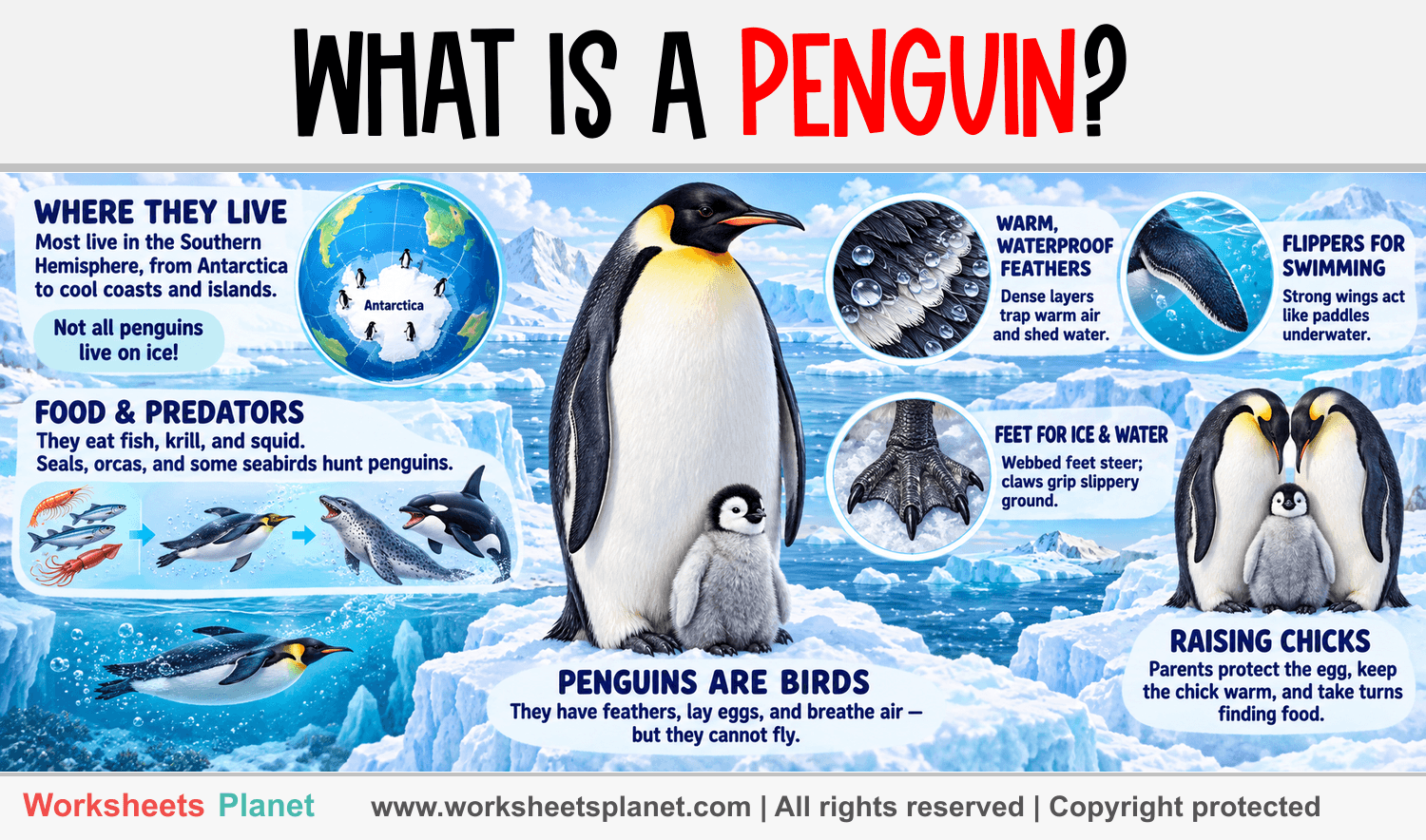
What is a penguin and why is it a bird?
A penguin is a type of bird, even though it cannot fly through the air. Like other birds, penguins have feathers, lay eggs, breathe with lungs, and are warm-blooded. This means their bodies can keep a steady temperature even when the outside environment is cold.
Penguins belong to a group of birds that have evolved to “fly” underwater instead of in the sky. Their wings are shaped like strong flippers, which help them move quickly through the ocean. On land, penguins may look slow and clumsy, but in water they are graceful, powerful swimmers.
The familiar black-and-white coloring of many penguins is not just for appearance. It is a form of camouflage called countershading. From above, a penguin’s dark back blends with the deep ocean. From below, its white belly blends with the bright surface of the water. This helps protect penguins from predators and makes it easier for them to hunt.
- Penguins have feathers, not fur.
- They lay eggs and care for their chicks.
- Their wings have become flippers for swimming.
- They are warm-blooded, like other birds and mammals.
Where do penguins live?
Penguins live almost entirely in the Southern Hemisphere. The largest numbers are found around Antarctica and nearby islands, but not all penguins live in snow and ice. Some species live on rocky beaches, grasslands, coastal deserts, or temperate islands.
The emperor penguin is famous for surviving the extreme cold of Antarctica. In contrast, the Galápagos penguin lives near the equator, where the climate is much warmer. This shows that penguins are not all the same; each species is adapted to its own habitat.
Penguins usually need access to the ocean because most of their food comes from the sea. They often gather in large groups called colonies. Living in a colony can help penguins find mates, protect chicks, and survive in challenging environments.
- Antarctica is home to emperor and Adélie penguins.
- Southern Africa has African penguins.
- South America has Humboldt and Magellanic penguins.
- New Zealand and nearby islands have several penguin species.
- The Galápagos Islands are home to the only penguins found north of the equator.
How are penguins adapted for swimming and survival?
Penguins have many body features that help them survive. Their streamlined shape reduces drag in the water, allowing them to swim smoothly. Their flippers act like paddles, while their feet and tail help with steering. Some penguins can dive very deep to search for food.
Penguin feathers are short, dense, and waterproof. A layer of oil from a gland near the tail helps keep water from soaking through. Under the feathers, many penguins also have a layer of fat called blubber, which helps keep them warm in cold water.
On land, penguins stand upright and often waddle. Some slide on their bellies across ice, a movement called tobogganing. This can save energy and help them travel faster over slippery surfaces. In very cold places, penguins may huddle together to share warmth.
- A streamlined body helps penguins swim efficiently.
- Dense feathers provide insulation.
- Blubber helps protect against cold temperatures.
- Flippers provide power while swimming.
- Group huddling helps penguins stay warm.
What do penguins eat and what eats penguins?
Penguins are carnivores, which means they eat other animals. Their diet usually includes fish, squid, and krill. The exact food depends on the species and where it lives. Penguins catch food by diving underwater and using their sharp beaks to grab prey.
Penguins are an important part of the ocean food chain. They help control populations of small sea animals, and they also provide food for larger predators. In the wild, adult penguins may be hunted by leopard seals, sea lions, and orcas. Eggs and chicks can be taken by birds such as skuas and giant petrels.
Because penguins depend on healthy oceans, changes in the marine environment can affect them. If fish or krill become scarce, penguins may have to swim farther to find food. This can be especially difficult when adults are feeding hungry chicks.
- Common penguin foods include krill, small fish, and squid.
- Predators may include leopard seals, orcas, sea lions, and seabirds.
- Penguins are both hunters and prey in their ecosystems.
How do penguins raise their chicks?
Penguins lay eggs, but their nesting habits differ by species. Some penguins build nests from stones, grass, or other materials. Others, such as emperor penguins, do not build a nest at all. Instead, the egg is kept warm on the parent’s feet under a flap of skin called a brood pouch.
Many penguin parents share the work of raising chicks. One parent may stay with the egg or chick while the other goes to sea to find food. When the hunting parent returns, it feeds the chick by bringing up food from its stomach. This may sound unusual, but it is a normal and important part of penguin care.
Penguin chicks are usually covered in soft down when they hatch. This down keeps them warm on land, but it is not waterproof like adult feathers. Before young penguins can swim, they must grow their waterproof feathers. This change is called molting.
- Penguins lay one or two eggs, depending on the species.
- Parents often take turns protecting and feeding the chick.
- Chicks need waterproof adult feathers before entering the ocean.
- Colonies can help provide safety, but chicks still face danger from weather and predators.
Why are penguins important to learn about?
Penguins are useful animals for studying adaptation. Their bodies show how living things can change over time to survive in specific environments. A penguin’s flippers, feathers, coloring, and social behavior all help it live successfully in or near the ocean.
Penguins can also teach students about environmental change. Some penguin populations are threatened by overfishing, pollution, habitat disturbance, and climate change. When ocean temperatures shift or sea ice changes, the food available to penguins can also change.
Protecting penguins means protecting the oceans they depend on. Simple classroom discussions about penguins can lead to larger lessons about ecosystems, conservation, and human responsibility. A penguin may look like a charming bird in a tuxedo, but it is also a remarkable example of survival in nature.
- Penguins show how animals adapt to land, water, and climate.
- They help students understand food chains and ecosystems.
- Their populations can give clues about the health of ocean environments.
- Learning about penguins encourages respect for wildlife and habitats.

Leave A Comment