
A black hole is one of the most fascinating objects in space. It is a region where gravity is so strong that nothing, not even light, can escape once it gets too close. Although a black hole may sound like an empty hole, it is actually made of several important regions and features. Learning the parts of a black hole helps students understand how black holes form, how scientists study them, and why they affect stars, gas, and even light around them.
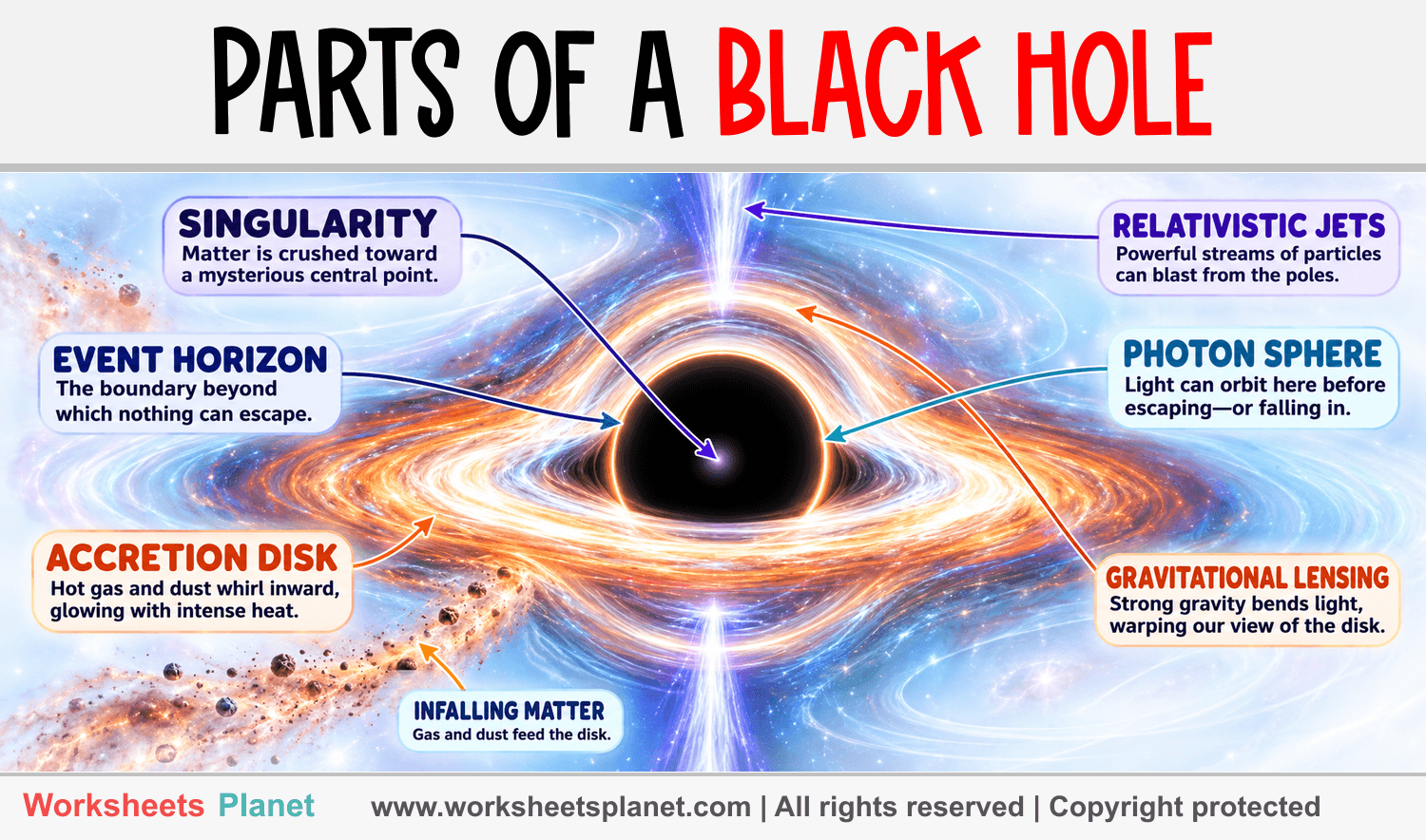
What are the main parts of a black hole?
The main parts of a black hole are not like the parts of a machine or a planet. Many of them are invisible boundaries or regions defined by gravity, motion, and light. Scientists describe these parts using physics and by observing how nearby matter behaves.
A simple way to picture a black hole is to imagine several zones. At the center is the singularity, where matter is squeezed into an extremely tiny space. Around it is the event horizon, the point of no return. Outside that, there may be swirling hot material called an accretion disk, and in some black holes, powerful jets of energy shoot into space.
- Singularity: the central point where mass is packed into an incredibly small region.
- Event horizon: the boundary beyond which nothing can escape.
- Accretion disk: a spinning disk of hot gas and dust around some black holes.
- Photon sphere: a region where light can orbit the black hole briefly.
- Relativistic jets: narrow beams of particles and energy launched from near some black holes.
The singularity: the mysterious center
The singularity is often described as the center of a black hole. It is the place where the black hole’s mass is concentrated. According to current scientific models, the gravity there becomes so intense that space and time are curved in extreme ways.
For students, it is helpful to think of the singularity as the part we understand the least. Scientists cannot directly observe it because it is hidden behind the event horizon. Also, the known laws of physics do not fully explain what happens at such extreme density. This is why black holes are important in the study of gravity, space-time, and the search for new physics.
Not every scientist imagines the singularity in exactly the same way. Some theories suggest that future discoveries may change our understanding of this center. However, in basic astronomy, the singularity remains a key part of how black holes are explained.
The event horizon: the point of no return
The event horizon is one of the most important parts of a black hole. It is not a solid surface. Instead, it is an invisible boundary around the black hole. Once anything crosses this boundary, it cannot escape because it would need to travel faster than light, which is not possible according to our current understanding of physics.
The size of the event horizon depends on the mass of the black hole. A black hole with more mass has a larger event horizon. For example, a black hole formed from a collapsed star may have an event horizon only a few kilometers across. A supermassive black hole at the center of a galaxy can have an event horizon millions or billions of kilometers wide.
The event horizon is also the reason black holes look black. Light from inside this boundary cannot reach our telescopes. Scientists detect black holes by studying what happens just outside the event horizon, such as the movement of stars, gas, and glowing material nearby.
- It is not a physical wall or surface.
- It marks the distance where escape becomes impossible.
- It grows larger when a black hole has more mass.
- It hides the singularity from outside observers.
Accretion disks and the matter around black holes
Many black holes are surrounded by an accretion disk. This disk forms when gas, dust, or pieces of a star are pulled toward the black hole but do not fall straight in. Instead, the material spirals around the black hole at very high speeds, heating up as it rubs together.
Accretion disks can become incredibly hot and bright. In fact, the area around a black hole can shine more brightly than many stars, even though the black hole itself gives off no light. This bright glow helps astronomers find black holes in space.
A famous example is found in galaxies with active centers, where a supermassive black hole is feeding on surrounding material. These regions can release huge amounts of energy. The accretion disk shows that a black hole’s influence is not limited to what is inside the event horizon; it can affect a large area around it.
Photon spheres, jets, and other important regions
The photon sphere is a region outside the event horizon where light can travel in curved paths around the black hole. Light does not usually stay there for long, but the idea helps explain why black holes can bend and distort the view of objects behind them. This bending of light is called gravitational lensing.
Some black holes also produce relativistic jets. These are powerful streams of particles and energy that shoot out from near the black hole’s poles. The jets do not come from inside the event horizon, because nothing can escape from there. Instead, they are thought to form when magnetic fields and fast-moving material near the black hole launch particles outward at nearly the speed of light.
Another useful term is the ergosphere, which is found around rotating black holes. In this region, space-time itself is dragged around by the spinning black hole. This effect is called frame dragging. It shows how rotation can change the structure around a black hole.
- Photon sphere: helps explain how black holes bend light.
- Relativistic jets: can stretch for thousands of light-years in space.
- Ergosphere: exists around spinning black holes and is linked to dragged space-time.
Why learning the parts of a black hole matters
Understanding the parts of a black hole gives students a clearer picture of how these objects work. A black hole is not simply a dark circle in space. It includes boundaries, regions of motion, extreme gravity, and sometimes glowing disks and powerful jets.
These parts also help explain how scientists study something that cannot be seen directly. By observing stars orbiting an invisible object, light bending around it, or gas heating in an accretion disk, astronomers can gather evidence for a black hole’s presence.
The parts of a black hole connect many big science ideas: gravity, light, energy, motion, and the life cycle of stars. They also show that space is not empty or simple. Around a black hole, the universe behaves in some of its most extreme and surprising ways.

Leave A Comment